Driving in Pattaya: A Guide for Tourists
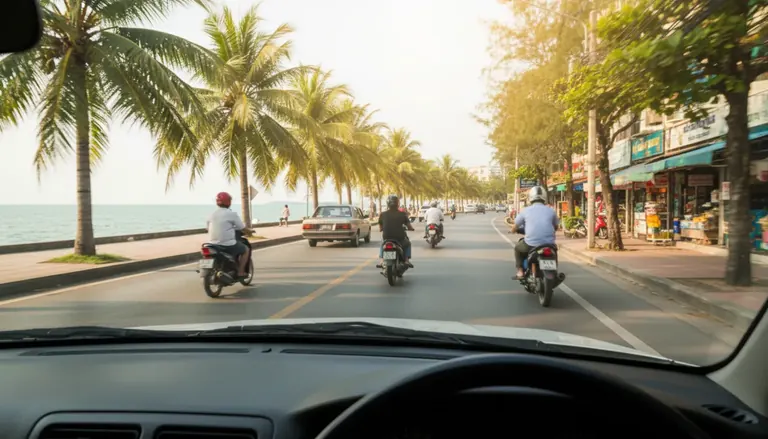
Thailand drives on the LEFT in right-hand-drive cars, and the indicator and wiper stalks are swapped — the classic first-day mistake. This guide covers the rules, the Sukhumvit U-turns, the local driving style, and parking in Pattaya.
Compare Car Rental DealsSearch & Compare Car Rental Deals
Free cancellation on most vehicles
Thai Road Rules for Tourists
Thailand uses left-hand traffic, and every rental car is right-hand drive — the steering wheel sits on the right. The pedals are arranged exactly as you expect, so that part is automatic. The trap is the stalk layout: the indicator and the wiper levers are swapped compared with European and US cars. For the first day you will reach for the turn signal and switch on the wipers instead. It is harmless but constant, and it tells you your autopilot has not adjusted yet. Most drivers settle into the new geometry within about a day.
Drive on the LEFT. Overtake on the RIGHT. In a right-hand-drive car the driver sits closest to the centre line, not the kerb. If your passenger is near the kerb, you are positioned correctly. Expect 'wrong-side drift' on quiet streets and clockwise roundabouts — the Dolphin Roundabout in North Pattaya turns the opposite way to what you may be used to, so slow down and watch the flow before you commit.
Speed Limits and Enforcement
There is no single national number that applies everywhere — drive to the sign in front of you. AI cameras around Pattaya now enforce speed, red lights, and failure to yield at pedestrian crossings automatically, so a fine can arrive without any officer present. The speeding penalty was raised to as much as 4,000 THB.
| Area | Limit | Practical note |
|---|---|---|
| Urban Pattaya streets | 50–60 km/h | Drop to 30–40 km/h near schools and hospitals |
| Rural — Sukhumvit Hwy 3 | 90 km/h | Watch for U-turn cuts across fast traffic |
| Motorway 7 | Up to 120 km/h | Toll motorway only, not the Sukhumvit spine |
| Speeding fine | Up to 4,000 THB | AI cameras issue automatically; raised from 1,000 |
Alcohol, Seatbelts and Phones
The blood-alcohol limit is 0.05% in general, but it drops to 0.02% for anyone holding a licence under five years — which describes nearly every tourist driving on an International Driving Permit. In practice that is effectively zero tolerance. DUI in Thailand is a criminal matter, not an administrative one: a first offence runs 5,000–20,000 THB and up to a year in jail, with possible visa cancellation or deportation. Pattaya runs frequent night checkpoints on Sukhumvit, Thep Prasit, Thappraya, and around Walking Street. If you plan to drink, leave the car.
| Rule | What the law says | Fine |
|---|---|---|
| Seatbelts | Mandatory for all occupants, including rear seats | Up to 2,000 THB each |
| Child restraint | Required under age 6 or under 135 cm (2023 law) | Request the seat when you book |
| Mobile phone | Hands-free only | 4,000 THB |
| Daytime headlights | Recommended in heavy rain | Improves visibility in downpours |
The IDP Detail That Voids Your Insurance
Carry three documents in the car at all times: a 1949 Geneva Convention International Driving Permit, your original home licence, and your passport. This convention choice is not a formality. Thailand ratified the 1949 Geneva Convention but not the 1968 Vienna Convention, and some EU countries issue 1968-only permits. After a crash, an insurance surveyor can use a 1968-only IDP to void your Class 1 cover entirely. Driving without a valid IDP also draws an on-the-spot 500–1,000 THB fine and leaves you uninsured. Verify the convention on your permit before you fly — it is not something you can fix at a checkpoint.
Wrong-convention IDP = voided insurance. Make sure your permit cites the 1949 Geneva Convention specifically. A 1968-only permit is legally accepted at the roadside but can be used by a surveyor to reject your claim after an accident. If you are booking a car for a longer trip, you can compare Pattaya car rental deals early and confirm your documents while there is still time.
Pattaya's Roads and the Local Driving Style
Sukhumvit Road — Highway 3 — is the spine of the city and the eastern boundary of the tourist zone. It carries both local traffic and long-haul movement, and its single biggest danger is the unsignalised U-turn cut: gaps in the median where cars swing across 90 km/h traffic to reverse direction. These cuts are notorious for fatal crashes. If you are joining or crossing through one, treat the moving traffic as having absolute priority and wait for a genuine gap rather than nosing out.
Inside central Pattaya the core runs on a one-way system that confuses first-time drivers. Beach Road runs one-way south, Second Road runs one-way north, and a ladder of narrow sois connects them between. Navigation apps handle this correctly, but if you try to drive against the flow on instinct you will meet a wall of oncoming vehicles. Thep Prasit Road links Sukhumvit down to Jomtien and clogs badly on weekend night-market evenings. Jomtien Beach Road had its two-way traffic restored in December 2025 after drainage works, so older maps may still show it differently.
How Pattaya Traffic Actually Behaves
- Might is right. Buses and trucks expect smaller vehicles to yield, and they will take the space whether you give it or not. Cars defer to anything larger.
- Baht buses (songthaews) stop anywhere, without warning. These blue pickup taxis pull over the instant a passenger waves. Keep a generous following distance and never sit directly behind one in the kerbside lane.
- Motorbikes filter on both sides and undertake. They appear in your blind spots from the left and the right. Mirror-check before every lane change and every turn.
- A headlight flash means the opposite of what you expect. In Thailand an oncoming flash means 'I am coming through, you give way' — not the Western 'after you'. Do not pull out in front of a flashing vehicle.
- The horn is a friendly heads-up, not anger. A light tap means 'I am here' or 'I am passing'. Do not read it as aggression, and use it the same way yourself.
Once you are comfortable with the city grid, the surrounding province opens up easily by car. Our guide to day trips from Pattaya covers the routes that reward having your own vehicle, from the temple country south of the city to the zoos and piers further out.
Distances and Drive Times
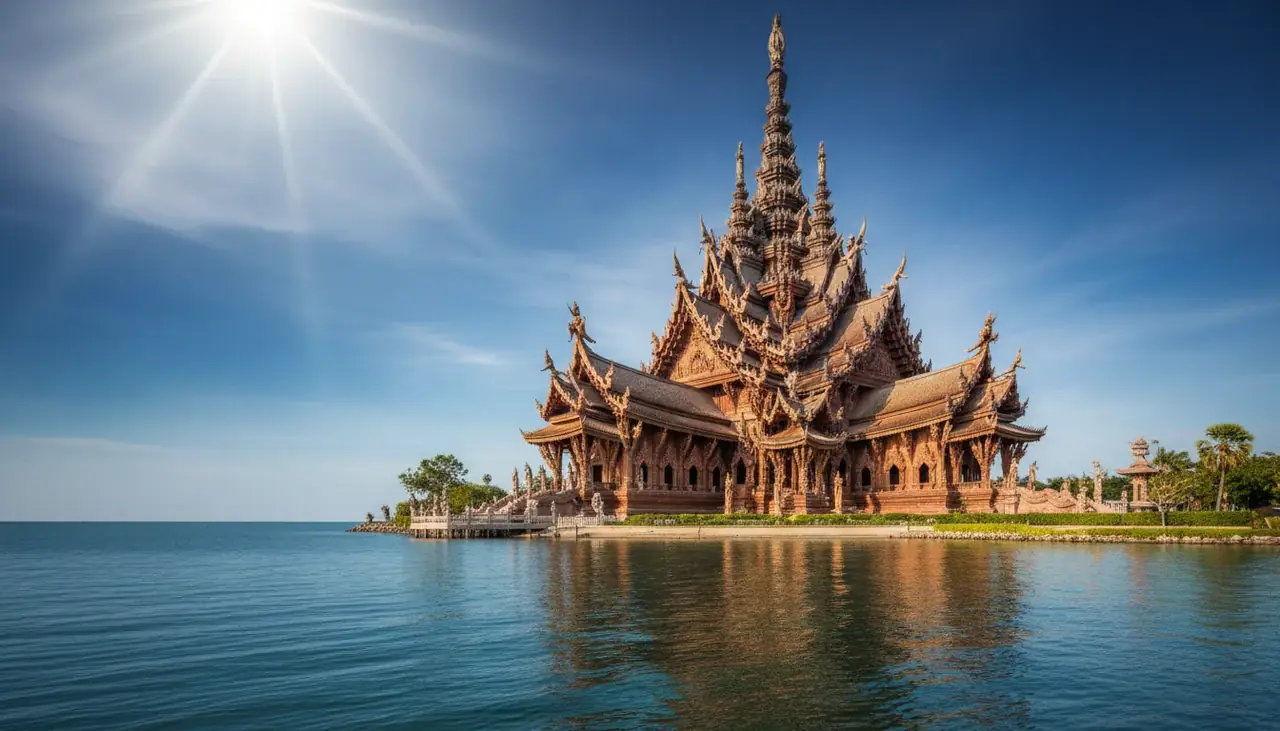
Pattaya is compact, but its best attractions are spread across the eastern seaboard, and several are awkward to reach by baht bus or taxi. The table below gives realistic driving times from the central city. Anything under 5 km is easy on foot or by songthaew; it is the 20-to-90-minute trips where a rental car pays for itself, letting you string several stops together in a day and skip the negotiation that comes with hired transport.
| Destination | Distance | Drive time |
|---|---|---|
| Jomtien | 4–5 km | 10–15 min |
| Naklua | 3–5 km | 10–15 min |
| Sanctuary of Truth | 5 km | 15–20 min |
| Nong Nooch Garden | 23–24 km | 25–30 min |
| Khao Chi Chan (Buddha Mountain) | 24–29 km | 22–30 min |
| Sriracha / Bang Saen | 32 km | 30–40 min |
| Khao Kheow Open Zoo | 35–45 km | 45–60 min |
| U-Tapao Airport (UTP) | ~40 km | ~45 min |
| Ban Phe pier (for Ko Samet) | 80–87 km | 1 h 10 – 1 h 35 |
| Bangkok (BKK) | 140–150 km | 1.5 – 2.5 h |
The trips that most justify a car are the cluster south of the city — Nong Nooch, Khao Chi Chan, and the Aquaverse water park — which sit close together off Sukhumvit and are tedious to chain by taxi. Ban Phe pier is the other strong case: it is the jumping-off point for Ko Samet and far cheaper to reach with your own car than by private transfer. For a full itinerary breakdown, see our day trips from Pattaya guide. Allow extra time on the Bangkok run — the 1.5-hour figure assumes light traffic, which the Friday-evening corridor rarely provides.
Parking in Pattaya and Jomtien
Parking is the real friction point of driving in central Pattaya, and the kerb colours tell you most of what you need to know before you stop. Reading them correctly is the difference between a convenient pause and a wheel clamp.
- Red-and-white kerb — no stopping at any time. Vehicles here are clamped or towed; recovering the car means a trip to the police station.
- Yellow-and-white kerb — bus or loading zone. No parking, though brief stops to drop off are sometimes tolerated.
- Plain or black-and-white kerb — parking is usually fine if there is no sign saying otherwise. When in doubt, find a marked lot instead.
For predictable parking, head to the malls. Terminal 21 Pattaya has a large garage that is often free for the first few hours. Central Festival has underground parking that charges in peak periods but is central to Beach Road. Both let you leave the car and explore the core on foot rather than circling one-way sois. For the Ko Larn ferry, Bali Hai Pier has an automated garage at around 250 THB per day plus surface lots near 200 THB — book the car off your hands before you board the boat.
Jomtien Is Simply Easier
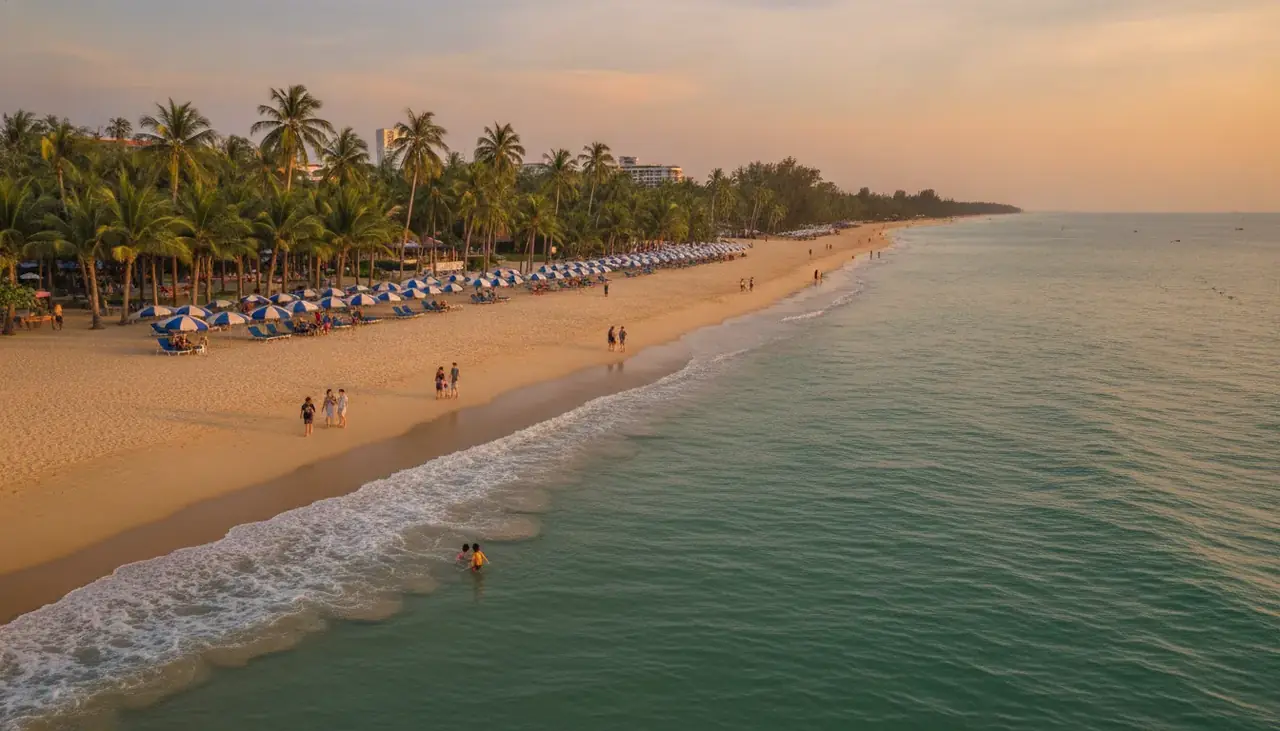
If you are basing yourself away from the one-way grid, Jomtien is far more forgiving to drive and park. Its beachfront has open kerbside parking that central Pattaya cannot match, and the wider streets make the left-side adjustment less stressful for first-timers. Many visitors who want a car for the week find a base here more practical — our Jomtien car rental page covers pickup options and what to expect on that side of the headland.
Fuel and Tolls
The major fuel chains across the Pattaya area are PTT, Bangchak (which absorbed the former Esso network), Shell, and Caltex. Most stations are full-service — an attendant fills the tank for you, so name the fuel type and the amount you want, for example 'Gasohol 95, full tank'. Cards are widely accepted at the big chains, but carry cash for smaller stations and rural stops where terminals can be unreliable.
Which Fuel Goes In (Mid-2026 Reference)
| Fuel type | Nozzle colour | Price (THB/litre) | Use it for |
|---|---|---|---|
| Gasohol 95 | Yellow | ~41–42 | Safe default for most petrol rental cars |
| Gasohol 91 | Green | ~40–42 | Fine for many economy engines |
| E20 | — | ~36–37 | Only if the fuel-cap sticker allows it |
| Diesel B7 | Blue | ~39 | Pickups and diesel SUVs only |
Fill only what the fuel-cap sticker specifies. Cheaper E20 saves a few baht but will damage an engine not rated for it, and petrol in a diesel tank — or the reverse — is a costly mistake that no standard insurance policy covers. If you are unsure, the attendant can read the sticker for you; do not guess by price.
If your driving includes the Bangkok corridor or a transfer, Motorway 7 uses electronic tolling and the modern M-Flow system rather than cash booths on some stretches. We cover how that works for arrivals on our airport & transfers page, including how rental companies handle toll charges.
Seasons, Weather and Safety
When you drive in Pattaya matters as much as how. The monsoon runs May through October, and the danger is speed of onset: Sukhumvit, Third Road, and the rail-side roads can flood up to roughly 0.5–1 m within thirty minutes of heavy rain, then take two to three hours to drain. The first few minutes of a downpour are also the most slippery, as water lifts oil residue off the asphalt.
Never drive into deep standing water. If the engine hydro-locks, the damage is deemed driver negligence and is not covered by insurance. When a road is flooded, wait it out or turn around. There is also a new 10,000 THB fine for splashing pedestrians, so slow right down where people are walking the kerb.
The cool, peak season from November to February brings the best weather and the worst congestion — evening speeds in the centre drop to 5–10 km/h and parking gets scarce. The hot season in March and April adds heat fatigue, and mid-April brings Songkran. The festival's 'Seven Dangerous Days' combine water-throwing crowds in the road with a sharp spike in drink-driving; minimise driving that week, keep your windows up, and stay off rural roads after dark.
If You Have an Accident
The first five minutes decide whether your claim survives. Stop and switch on hazard lights, then photograph everything before any car is moved — vehicle positions, plates, damage, and the other driver's licence. Do not admit fault, apologise in a way that sounds like an admission, or sign any Thai-language document you cannot read. Call your rental company and the insurer's 24-hour line: a mobile surveyor will attend, deal with the police, and arbitrate the scene. With a Class 1 policy your car is repaired regardless of who caused the crash, so there is no advantage to negotiating on the roadside.
Emergency Numbers
| Number | Service |
|---|---|
| 191 | Police — general emergency |
| 1155 | Tourist Police — English-speaking, first call for tourist incidents |
| 1669 | National EMS — ambulance and medical emergency |
| 1193 | Highway Police — for incidents on major intercity roads |
The Tourist Police line (1155) is staffed by English speakers and is the right number if there is any ambiguity about fault or the other party becomes difficult. Driving in Pattaya is very manageable once you respect the left-side adjustment, the Sukhumvit U-turns, and the weather — and with the right vehicle for your plans it opens up the whole eastern seaboard. When you are ready, compare Pattaya car rental deals to see what categories are available for your dates.
Ready to compare car rental deals in Pattaya?
Check live prices and availability from local and international suppliers.
Compare car rental deals